Today I want to answer a question I get a lot: how much cash should I keep at home? I’m talking about physical cash at home, in your hand, not the emergency fund sitting in your savings account. Both matter. But only one of them works when the power is out and the bank’s app is spinning.
Why do you need cash at home? Banks go down. Card readers go down. Apps go down. Usually it lasts a few hours, sometimes a few days, and it almost always happens on a regular old Tuesday when you need gas, groceries or a prescription.
This past week, preppers on Reddit were swapping notes about bank outages, data breaches and big hacks. The advice that got the most upvotes wasn’t scary. It was boring. Keep some cash. Keep some paper. Have a backup. One reader put it perfectly: most emergencies are just Tuesdays.
That’s the plan here. Nothing crazy. Just the boring stuff that gets you through a bad Tuesday.
Heads up: this post contains affiliate links. If you buy through them, Skilled Survival may earn a commission at no extra cost to you.
Why Physical Cash Matters When Banks, Cards or Apps Go Down
We live in a tap-to-pay world. That’s great, right up until it isn’t.
When the power goes out, the card reader at the gas station is a big expensive paperweight. When your bank has an outage, your debit card and your payment apps can both go dark at the same time. And when a breach hits, a bank may freeze cards while it sorts things out.
Why does cash matter in all three? Because cash doesn’t need power, a signal or a server. It just needs a person willing to take it.
Ready.gov says the same thing in plain English. It tells families to keep a small amount of cash at home in a safe place, and to keep small bills, because ATMs and credit cards may not work during a disaster (Ready.gov financial preparedness).
Here are the benefits of keeping cash at home in a nutshell:
- It works offline. No power, no internet, no problem.
- It works during a bank or card outage. Even a short one.
- It keeps you out of the ATM line. When everyone else remembers cash at the same time, ATMs run dry.
- It buys you calm. Knowing you can fill the tank and buy groceries takes a lot of panic out of a bad day.
Now, the flip side. Cash can burn, flood or walk away with a burglar, and your insurance probably won’t cover much of it. More on that below. That’s why the goal is a sensible amount, not a mattress full of money.
How Much Cash Should I Keep at Home?
Here’s the honest answer: there’s no one right number for how much cash to keep at home. It depends on what YOUR household actually spends. A number from the internet won’t help you much. Your own grocery bill will.
So let’s roll up our sleeves and do the math. It’s simple:
Daily essentials x number of days + one tank of gas + one night somewhere else = your cash target
Daily essentials means groceries, medicine, pet food, diapers, and anything else you’d buy no matter what. Leave out the stuff you could skip for a week. (And no, the streaming subscription is not an essential.)
The 3 tiers
| Tier | What it covers | Example: family of 4 |
|---|---|---|
| 72 hours | A short bank or power outage. Groceries, gas, medicine, maybe a motel night if you have to leave. | About $75 a day x 3 = $225, plus $60 of gas and $150 for a motel night = about $435. Round up to $500. |
| 2 weeks | A longer regional outage or a frozen account while the bank sorts out fraud. | About $75 a day x 14 = $1,050, plus two tanks of gas = about $1,170. Call it $1,200 to $1,500. |
| 1 month | A serious disruption. The bills that only take cash, plus a month of essentials. | Your real monthly essentials. For many families that’s $2,500 or more. |
Those example numbers are just that, examples. Run your own.
So how much emergency cash should I have at home? Start with the 72-hour tier. It’s the one you’re most likely to use, and it’s a small enough amount that losing it wouldn’t wreck you. Once that’s done, build up to two weeks a little each payday.
I’d stop there for most families. Past two weeks, the risks of keeping a pile of cash at home (fire, theft, temptation) start to outweigh the benefits. The rest belongs in an insured bank or credit union, which is still the right home for your real emergency fund.
Keep it in small bills
When the registers are down, nobody can make change for a $100 bill. Heck, they may not be able to make change at all.
So keep small bills. For a $500 stash, I’d aim for something like this:
- 20 x $1 bills ($20)
- 12 x $5 bills ($60)
- 10 x $10 bills ($100)
- 16 x $20 bills ($320)
Throw in a roll of quarters too. It’s handy for vending machines and laundromats when the card readers are out.
↓ Keeping CASH for EMERGENCIES – What You NEED to Know!
The Safest Place to Keep Cash at Home
Okay, so you’ve got your cash. Now where does it go?
The safest place to keep cash at home is a fire and water resistant safe that’s bolted to the floor and isn’t in the master bedroom closet. That’s where burglars tend to look first.
Why fire AND water? Because fires get put out with hoses. A safe that survives the heat but fills with water won’t save your bills or your papers. Look for a safe with a fire rating from a testing lab like UL plus a water rating, like the SentrySafe SFW123GDC fire and water resistant safe. The maker says it’s UL Classified for 1 hour of fire protection and ETL verified for 24 hours in up to 8 inches of water.
A small safe is easy to carry off, so bolt it down. Most home safes come with pre-drilled holes for exactly that.
How to store cash in a safe
- Bag it. Seal the bills in zip-top bags, one per denomination. It keeps them dry and makes counting easy.
- Keep it off the floor of the safe. If water gets in, it starts at the bottom.
- Write down what’s in there. A simple list, dated, kept in your binder. It tells you what you have and when you last checked.
- Tell one person you trust. If you’re the only one who knows where the cash is, your family can’t use it when you’re not home.
Where to hide cash at home (and where not to)
Hiding cash at home works best when you split it up. If a burglar finds one stash, he doesn’t find them all.
Here’s how I’d split it:
- The main stash goes in the bolted-down safe.
- A grab-and-go envelope lives with your emergency binder or bag, so it leaves with you if you have to evacuate.
- A small decoy or backup stash goes somewhere boring. A diversion safe that looks like a can of food or a book on a shelf of other books works well.
And here’s where NOT to put it:
- Under the mattress. It’s the first place anyone checks. It’s a cliche for a reason.
- The freezer. Everyone has heard this one, including burglars.
- The toilet tank. Wet money. Need I say more?
- The car. Keep a little in your get-home bag if you like, but not your main stash.
Check your insurance
Here’s the part most people don’t know. A standard HO-3 homeowners policy only covers $200 in money, and that same $200 limit covers bullion and coins (New York DFS). Some insurers sell an endorsement to raise it.
The bottom line is this: if your house burns down, the cash in it is mostly gone. That’s one more reason to keep the amount sensible.
Want a free 78 item preppers checklist?
Enter your email below to instantly download this Complete Checklist PDF. No purchase necessary. 👇 👇The Paper Plan: Your Emergency Binder
Cash gets you through the store. Paper gets you through everything else.
When your phone is dead, the bank’s site is down, or you’re standing in a shelter line trying to prove who you are, a paper copy beats a password every time.
That’s what an emergency binder is. It’s one binder (or folder) with copies of the papers and numbers you’d need to restart your life after a fire, a flood, or a bad week of outages. I go deeper on which papers matter in my guide to bug out bag documents.
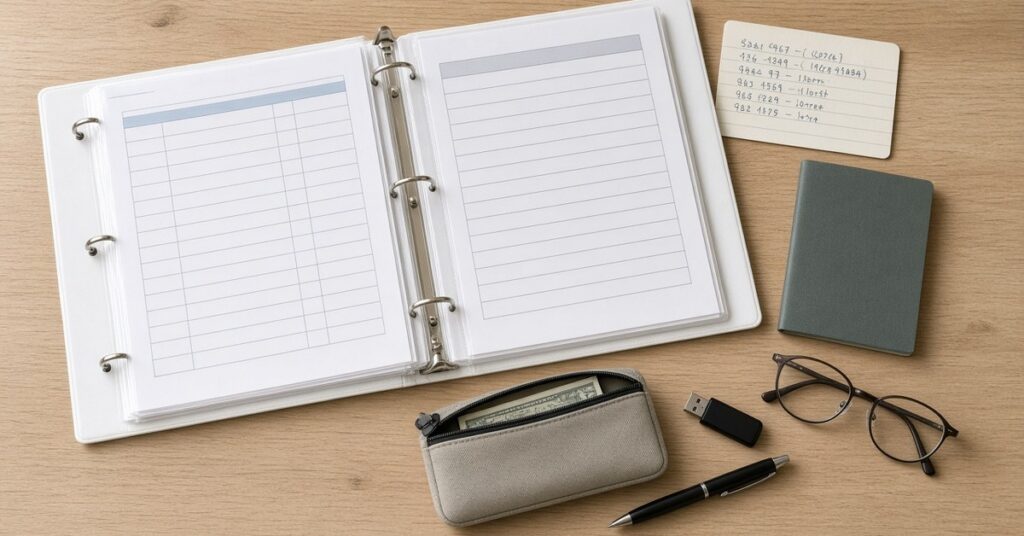
Emergency binder checklist
- IDs: copies of driver’s licenses, passports, birth certificates and Social Security cards
- Contacts: a paper list of family, neighbors, doctors, your employer, and an out-of-town contact. Most of us don’t know a single phone number by heart anymore.
- Money: bank and credit card account numbers plus the phone number on the back of each card
- Insurance: home or renters, auto, health and life policy numbers and agent phone numbers
- Medical: medication lists with doses, allergies, doctor and pharmacy info, copies of insurance cards
- Property: deed or lease, vehicle titles, and photos of your stuff for insurance claims
- Digital backups: printed two-factor backup codes for your email and bank, and a USB drive with scans
- Pets: vet records and a recent photo of each pet
- Cash: the small grab-and-go envelope
Ready.gov and FEMA put out a free workbook for exactly this, the Emergency Financial First Aid Kit. It’s worth printing.
Keep the binder in your safe, or in a fire-resistant document bag you can grab on the way out the door. One note on those bags: they’re fire-resistant, not fireproof, and the heat ratings are the maker’s claims. Put the bag inside your safe for the best protection.
↓ Building Your Important Document Binder
Open a Second Bank or Credit Union Account
This one is cheap insurance, and almost nobody does it.
If all your money is in one bank, one outage or one fraud freeze cuts you off completely. A second account at a different bank or a local credit union gives you a backup card and a backup app.
- Pick a different institution, not just a second account at the same bank.
- Keep a working balance in it, enough for a week or two of groceries and gas.
- Carry or store the second card separately from your main one.
- Make sure it’s insured. Look for FDIC coverage at a bank or NCUA coverage at a credit union.
Same idea with credit cards. Having two cards on two different networks means one bad day at one company doesn’t stop you cold.
Set Up Your Phone’s SOS and Offline Features Now
Your phone is still the most useful tool you own in an emergency, if you set it up before you need it.
- Turn on Emergency SOS. Both iPhone and Android have it. Learn the button press so you’re not guessing in the moment.
- Fill out your Medical ID or emergency information. First responders can see it from the lock screen.
- Check for satellite texting. Newer iPhones and some newer Android phones can reach emergency services by satellite when there’s no cell signal. See if yours can, and try the demo.
- Download offline maps of your area and your evacuation route.
- Save key documents for offline use, like your insurance cards and medication list.
- Lock down your accounts. Turn on two-factor login for your email and bank, and print the backup codes for your binder. After a big breach, that’s the step that matters most.
- Keep a charged power bank by the binder.
Another Form of Currency: A Little Gold and Silver
 Let me be clear about what this section is and isn’t.
Precious metals are NOT your first prep. If you don’t have food, water and the cash above, start there. Nobody’s going to trade you a can of beans for a coin when their own pantry is empty.
But once the basics are covered, it makes sense to hold a little value outside the banking system. Cash is great for a bad Tuesday. It’s not great if a bad Tuesday turns into a bad year and inflation eats it. A small amount of metal is just another form of currency to have on hand if SHTF.
The key is small, recognizable pieces you could actually spend or trade:
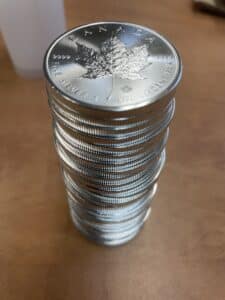
- 1 oz silver rounds, simple and easy to recognize
- junk silver, which means pre-1965 US dimes, quarters and half dollars that are 90% silver. People already know what a dime looks like.
- fractional gold, like 1/10 oz coins, if you want a lot of value in a tiny space
Buy from a reputable dealer like SD Bullion, keep it in the same safe as your cash, and don’t brag about it. I’ve written before about how survival gold and SHTF silver can make you a target if the wrong people know you have it. And remember that $200 insurance limit covers bullion and coins too.
↓ Ask Jack: What’s Better For Bartering After TEOTWAWKI?

Your “Outage Tuesday” Checklist
Here’s your simple action plan. Do one thing a week and you’ll be done in about two months.
- Figure out your daily essentials number and your 72-hour cash target
- Pull out your 72-hour cash in small bills, plus a roll of quarters
- Get a fire and water resistant safe and bolt it down
- Split your cash: main stash, grab-and-go envelope, small backup stash
- Check your homeowners policy for the cash limit
- Build your emergency binder with the checklist above
- Open a second account at a different bank or credit union
- Set up Emergency SOS, Medical ID and offline maps on every phone in the house
- Turn on two-factor login and print your backup codes
- Tell one trusted person where the cash and binder are
- Build to two weeks of cash, a little each payday
- Once the basics are done, add a few small pieces of silver or gold
Check it all twice a year. I like doing it when the clocks change.
Want Help Building Your Plan?
If you’d like to work through this with other folks who are doing the same thing, come join us in The Resilient Life on Skool. It’s where we share what’s working, ask questions, and keep each other on track. No fear-mongering, just regular people getting a little more resilient every week.
Frequently Asked Questions
Yes, a modest amount. Ready.gov tells families to keep a small amount of cash at home in a safe place, in small bills, because ATMs and credit cards may not work during a disaster. Keep the rest of your savings in an insured bank or credit union.
Split it up. Keep most of it in a bolted-down fire and water resistant safe that isn’t in the master bedroom, a small grab-and-go envelope in your emergency binder or bag, and maybe a little in a diversion safe. Skip the mattress, the freezer and the toilet tank.
Seal the bills in zip-top bags, sorted by denomination, and keep the bag off the floor of the safe. Use a safe rated for both fire and water, bolt it down, and write down what’s inside so you know what you have and when to refresh it.
In the US there’s no federal limit on how much cash you can keep at home. Banks do have to report cash deposits or withdrawals over $10,000 in a day, and splitting transactions up on purpose to avoid that report is a crime called structuring. Also check your homeowners policy, since a standard HO-3 policy only covers $200 in cash.
Start with enough to cover 72 hours of your real spending, which is a few hundred dollars for most households. Then build to two weeks. Base it on your own groceries, gas, medicine and a possible motel night, not on a number from the internet.
Copies of IDs, birth certificates and Social Security cards, insurance policies, account numbers and bank phone numbers, a paper contact list, medication lists and doctor info, property records, printed two-factor backup codes, and a small envelope of cash.
Want a free 78 item preppers checklist?
Enter your email below to instantly download this Complete Checklist PDF. No purchase necessary. 👇 👇Final Thoughts
The bottom line is this: most emergencies aren’t the end of the world. They’re a Tuesday where the card reader doesn’t work.
So how much cash should you keep at home? Enough for 72 hours to start, two weeks when you can, in small bills, split up and locked in a safe. Add a binder full of paper, a second bank, a phone that’s set up right, and maybe a little silver once the basics are covered.
None of it is exciting. That’s the point. Boring prep wins.

Prepare, Adapt & Overcome,

P.s. - I just found out 2 out of 3 Americans don’t feel prepared for a 3 day disaster!!!

I guess this goes to show how modern society continues to embrace ‘living a fragile life.’ What’s crazy is… it’s so easy to fix.
To make sure YOU have the basics, watch our FREE training on “10 Simple Steps To Basic Preparedness” that shows you HOW.
Nothing crazy here… this isn’t doomsday prepping... just the basics every responsible adult should have before a disaster strikes.Why You Can Trust Skilled Survival...
Go here now to review a full breakdown of:
- Who We Are
- Our Credentials
- Our Mission
- & Product Recommendations...
Here are a few highlights of our teams credentials & certifications:
- Certified Member of a Mountain Search & Rescue Organization
- Plant Emergency & Safety Leader for a Major Food Manufacturer
- Member of the 10TH Mountain Division Hut Association
- Certifications: Avalanche 1, WFR, CPR
- Official Gear Tester for Numerous Outdoor Gear Companies
- Countless Multiday Backpacking trips into Remote Wilderness
- Bachelor's Degree In Mechanical Engineering
- Bachelor's Degree In Civil Engineering
- Bachelor's Degree In Biomedical Engineering
"It takes 20 years to build a reputation and five minutes to ruin it." - Warren Buffett
We're fully aware that trust is NOT something you GET but is EARNED.
And we'll continue to earn YOUR trust through our forthright and honest approach with each new Blog Post, Guide & Product we create...
P.s - While supplies last, you can get a FREE FireHawk Tactical Flashlight 👇

This is the best EDC flashlight I've ever owned.
Now you can too... for FREE. Just cover the reasonable S&H. 👍
Claim your FREE FireHawk Tactical Flashlights Here.