If you want the best solar generator for home backup, start with the fridge and the AC, not the marketing.
When the power goes out, most people worry about two things first. The food in the fridge, and staying cool (or warm) enough to sleep.
A solar generator can handle the fridge. It can handle a small AC unit for a while.
The ads make it sound like you can run your whole house off a box in the corner. That’s where people get burned.
So I’ll skip the hype and do the math. I’ll show you how to size a solar generator for home backup, what it really takes to run a refrigerator and an air conditioner, and which setup I’d point most families toward.
Quick note: Some links in this post pay Skilled Survival a commission. It doesn’t cost you anything extra.
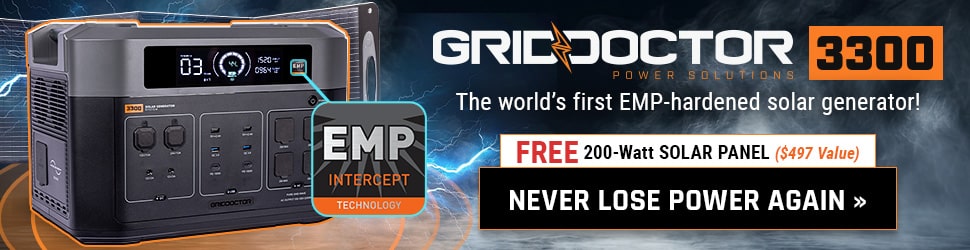
My Pick: Grid Doctor 3300 EMP Solar Generator + 3300XP Expansion Batteries
 For home backup, I’d go with the Grid Doctor 3300 Solar Generator System with EMP Intercept Technology from My Patriot Supply, and then add 3300XP expansion batteries based on what you need to run. Here’s why that combo makes sense for a house, not just a campsite:
- A big inverter. It’s rated for 3,300 watts continuous with a 6,600 watt surge. That surge headroom matters, because fridges and AC units pull a big spike every time the compressor kicks on.
- You can grow the battery. The base unit holds 2,048 watt hours. Each 3300XP adds another 2,048 watt hours, and you can stack up to seven of them for 16,384 watt hours total.
- Real solar input. The 3300 takes up to 1,000 watts of solar (up to five 200W panels), and one waterproof 200W panel comes in the box.
- Safer battery chemistry. It uses LiFePO4 (lithium iron phosphate) cells rated for 3,500 cycles. That’s the chemistry I want sitting inside my house.
- Built for the house. Pure sine wave output, five AC outlets, a 30 amp RV outlet, pass-thru charging, and UPS protection so your stuff stays on when the grid drops.
Now the honest part. The base unit by itself is not a whole-home backup. Even My Patriot Supply’s own listing says the average homeowner would need to pair the 3300 with multiple expansion batteries to keep a household running normally for three days. I agree with them, and the math below shows why.
How to Size a Solar Generator for Home Backup
There are only two numbers you need to understand.
1. Watts (Can It Start and Run It?)
Watts are how much power something pulls at one moment. Your generator’s inverter has to handle the total running watts of everything plugged in at once, plus the startup surge of anything with a motor or compressor. A Virginia Tech Extension guide on estimating appliance energy use notes that a motor can pull about three times more current when it starts than when it’s running smoothly. That’s why surge rating matters more than people think.
2. Watt Hours (How Long Will It Last?)
Watt hours are the size of your gas tank. A 500 watt load running for 2 hours uses 1,000 watt hours. You also lose some energy converting battery power to AC. I plan on getting about 85% of the rated capacity as usable power. That’s a rule of thumb, not a factory number, but it keeps you from being surprised. Here’s what that looks like:
- Grid Doctor 3300 alone: 2,048 Wh rated, about 1,740 Wh usable
- 3300 + one 3300XP: 4,096 Wh rated, about 3,480 Wh usable
- 3300 + two 3300XPs: 6,144 Wh rated, about 5,220 Wh usable
- 3300 + three 3300XPs: 8,192 Wh rated, about 6,960 Wh usable
- 3300 + seven 3300XPs (max): 16,384 Wh rated, about 13,900 Wh usable
Home Backup Sizing Table
These are typical numbers. Your appliances will be different, so check the nameplate or measure them (more on that below).
| Appliance | Typical Running Watts | Hours Per Day | Wh Needed Per Day |
|---|---|---|---|
| Full-size refrigerator (newer, ENERGY STAR) | About 125 to 220 W when the compressor runs (41 to 73 W averaged over the day) | 24 (cycles on and off) | 1,000 to 1,750 |
| Window AC, 8,000 BTU | About 530 W | 4 | About 2,130 |
| Window AC, 12,000 BTU | About 800 W | 4 | About 3,200 |
| Central AC, about 3 tons | About 3,000 to 3,500 W | 4 | 12,000 to 14,000 |
| LED bulbs (4 at 10 W) | 40 W | 5 | 200 |
| Wi-Fi router and modem | 15 to 20 W | 24 | 360 to 480 |
| CPAP (no heated humidifier) | 30 to 60 W | 8 | 240 to 480 |
| Microwave | 1,000 W | 0.25 | 250 |
| Phones (4 full charges) | Varies | Varies | About 50 |
Where those numbers come from: the refrigerator and window AC figures are based on ENERGY STAR certified product data, where median full-size fridges use about 363 to 640 kWh a year. The Department of Energy’s old rule of thumb is that a fridge runs at full power about a third of the time it’s plugged in, which is how you get the running watts. The central AC figure is a typical 3 ton system. Older fridges and older AC units can pull a lot more.
Can a Solar Generator Run a Refrigerator?
Yes. This is the job solar generators are best at. A newer full-size fridge only needs about 1,000 to 1,750 watt hours a day. The Grid Doctor 3300 by itself has about 1,740 usable watt hours, so on its own it can keep a newer fridge going for roughly a day, give or take, even with zero sun. The surge isn’t a problem either. A fridge compressor might spike to several hundred watts for a second when it starts. The 3300 is rated for a 6,600 watt surge, so it has room to spare. Add one 3300XP and you’re looking at around two days of fridge power on battery alone, longer if the sun is out and the panel is feeding it. A few ways to stretch it:
- Keep the doors shut. Every time you open it, the compressor has to work harder.
- Fill empty space with jugs of water. Cold mass holds the temperature.
- Turn the fridge to a slightly warmer (but still safe) setting during an outage.
- If you’ve got a separate deep freezer, that’s another load to budget for.
If you’re looking at a dedicated off-grid fridge instead, I covered those in my post on the best solar refrigerators.
↓ Fridge Backup Power: What Size Power Station Is Enough?
Can a Solar Generator Run an Air Conditioner?
It depends completely on which kind of AC you mean.
Window AC: Yes, for a Few Hours
A smaller window unit is realistic. Efficient inverter models are the ones I’d look at for solar backup, because they can ramp down once the room is cool instead of slamming on and off. An 8,000 BTU Midea U-shaped inverter lists 710 watts of cooling power. That’s the full-load number on the listing, not a guess.
If you need more cooling, the 12,000 BTU Midea U-shaped inverter lists 1,140 watts.
On the Grid Doctor 3300 alone, at those full-load numbers, that works out to roughly:
- 8,000 BTU window AC: about 2 to 2.5 hours of steady running
- 12,000 BTU window AC: about 1.5 hours of steady running
Add two 3300XP batteries and those numbers jump to roughly 7 hours and 4.5 to 5 hours. In the real world these inverter units ramp down once the room cools, and a compressor isn’t at full load the whole time, so you may get more than that. On a brutal afternoon you may get less. My advice: cool one room, not the house. Pick a bedroom, close the door, hang a blanket over the doorway if you have to, and run the AC during the worst heat of the day or at night so people can sleep. That’s especially important if you’ve got elderly family members, babies, or anyone with a medical condition.
Keep a Window AC in Your Stockpile, Even If You Have Central Air
If your house already has central air, you still want a window unit (or a couple of them) in the garage or a closet. Central air pulls far too much power for a solar generator, and for most portable generators too. When the grid goes down in a heat wave, that central system isn’t going to help you.
The plan is simple. Pick one room, close the door, hang
Store the unit with its mounting kit so you can get it in a window without a hardware-store run. Measure your windows now, not when the power is already out.
Mini-Split: Often Easier on a Battery
Small 120 volt mini-splits are usually inverter driven. That means they ramp down once the room is cool instead of slamming on and off. They tend to be easier on a battery than a window unit of the same size. Check the spec sheet for the voltage and running watts before you count on one.
Central AC: Not Realistic
This is where I have to be blunt. Running central air off a portable solar generator is not a realistic plan for most homes.
- A typical 3 ton central unit pulls around 3,000 to 3,500 watts while running. That’s right at or over the 3300’s continuous rating before you plug in anything else.
- Most central AC condensers are wired for 240 volts. I don’t see a 240 volt output listed for the Grid Doctor 3300.
- Even if you could connect it, the base battery would be empty in about half an hour. A fully maxed-out stack of seven expansion batteries would buy you roughly 4 hours.
If keeping the whole house cool through a long summer outage is a must, you’re shopping for a permanently installed whole-home system or a standby generator, not a portable solar generator. For most families, one cool room is the smart goal. 
Want a free 78 item preppers checklist?
Enter your email below to instantly download this Complete Checklist PDF. No purchase necessary. 👇 👇Three Home Backup Builds That Make Sense
Here’s how I’d size the Grid Doctor setup for different goals. These assume no sun at all, so anything the panels add is a bonus.
Build 1: Fridge and Essentials
Fridge, a few LED lights, Wi-Fi, phone charging, and maybe a CPAP. That’s roughly 1,800 to 3,000 watt hours a day. Setup: Grid Doctor 3300 + one 3300XP. That gives you about 3,480 usable watt hours, which covers one to two days on battery, and longer with the included panel pulling its weight.
Build 2: Essentials Plus One Cool Room
Everything in Build 1, plus an 8,000 BTU window AC for about 4 hours a day. At the 710 watts that 8,000 BTU inverter lists at full load, that’s roughly 4,600 to 5,800 watt hours a day. Setup: Grid Doctor 3300 + two 3300XPs. About 5,220 usable watt hours. Run the AC during the hottest stretch and let the rest of the day go to the fridge and essentials. If you’re running it at full load for hours, you may want a third XP or more solar coming in.
Build 3: Multi-Day Outage Plan
If you live somewhere with hurricane season, ice storms, or long grid outages, you want more battery and more solar. Here I’d go with the 3300 plus three or more 3300XPs, and add extra 200W panels so you’re actually putting back what you use each day.
Solar Recharging: What to Expect
The included 200W panel is a good start, but it won’t refill a big battery stack by itself. As a rough rule of thumb, a 200W panel might put back somewhere around 600 to 800 watt hours on a good sunny day, depending on your location, the season, and how well you aim it. Cloudy days, winter sun, and shade cut that way down. The 3300 can take up to 1,000 watts of solar (up to five 200W panels), so more panels is how you turn this from a few days of backup into something you can keep running. Each 3300XP also has its own solar input, capped at 200W. You can also charge the 3300 from a wall outlet at up to 1,800 watts in quick charge mode, so you can top it off fast when you know a storm is coming. (Don’t charge it from a GFCI outlet. The listing specifically warns against that.) If you want a deeper look at panels, see my guide to the best portable solar panels.
About the 3300XP Expansion Batteries
 The expansion batteries are what turn the 3300 into a real home backup system. A few things you should know before you buy:
- They’re built for the 3300. My Patriot Supply lists them as compatible with the Grid Doctor 3300 (including the new EMP version) and the Grid Doctor 2200. The URL still says “2200XP” but the current product is the 3300XP.
- Each one adds 2,048 watt hours. Stack up to seven on top of the 3300 for 16,384 watt hours total.
- They’re LiFePO4 too, rated for 3,500 cycles, and each one weighs 41 pounds.
- They have DC outputs only. On their own, an XP has a car port socket, USB-A, USB-C, and an XT90 port, but no regular AC outlets. Connected to the 3300, they feed the 3300’s AC outlets. Unplugged, they can run 12V and USB gear in another room.
- The 3300 charges them fast. The listing says the 3300 can charge an XP at up to 1,800W.
You can grab the 3300XP expansion batteries here.
What About the EMP Protection?
My Patriot Supply bills the Grid Doctor 3300 as the first EMP-hardened solar generator. According to the listing, its EMP Intercept Technology is built into the unit, protects against up to 260,000 amps of AC and 152,000 amps of DC, and reacts to surges in 3 nanoseconds. They say it’s designed to withstand an EMP from a high-altitude nuclear detonation, plus lightning strikes, grid surges, and solar flares. I’ll be straight with you. Nobody can independently test a real nuclear EMP on a consumer product, so I treat that as extra insurance, not a guarantee. The listing also doesn’t say whether that protection covers expansion batteries plugged into the unit, so I wouldn’t assume it does. If EMP is a big part of your planning, read my take on EMP shields vs surge protectors and my broader EMP protection plan.
How to Connect a Solar Generator to Your Home
There are two safe ways to do it. Extension cords. The simple way. Put the generator near the fridge and run heavy-duty cords to the other things you need. No electrician, no wiring. A transfer switch or power inlet. If you want to power essential circuits (fridge, a few lights, the furnace blower), have a licensed electrician install a transfer switch or inlet. Confirm with the electrician and My Patriot Supply that your setup works with the Grid Doctor before you buy parts. Never plug a generator into a wall outlet to backfeed your house. It can send power back down the line and kill a utility worker, and it can fry your gear when the grid comes back.
Measure Before You Buy
The single best thing you can do before buying any solar generator is measure what your appliances actually use. Plug your fridge into a Kill A Watt electricity usage monitor for 24 hours and it’ll tell you exactly how many kWh it burns in a day. Do the same with your window AC on a hot afternoon. That turns all the guesswork in this post into your own numbers. (Heads up: the Kill A Watt is for regular 120 volt plug-in appliances, not hardwired or 240 volt equipment.)
Who This Setup Isn’t For
If you just need to keep phones charged and run a light or a fan during short outages, the Grid Doctor 3300 is more than you need. Check out my picks for the best portable power stations for smaller, cheaper options. And if you’re mainly after something to haul to a campsite or RV, my portable solar generator guide covers that side of things. Also worth knowing: the 3300 weighs 52 pounds and each XP weighs 41. This is a park-it-and-leave-it home system, not something you grab and carry to the truck. And My Patriot Supply currently doesn’t ship Grid Doctor products to Canada.
Frequently Asked Questions
For a newer full-size fridge, plan on 1,000 to 1,750 watt hours per day plus an inverter that can handle the compressor’s startup surge. The Grid Doctor 3300 alone covers roughly a day. Add a 3300XP for about two days without sun.
Divide your usable watt hours by your fridge’s daily use. With about 1,740 usable watt hours, the 3300 runs a fridge that uses 1,200 Wh a day for roughly 34 hours. An older or bigger fridge will cut that down.
Yes, for a few hours. An 8,000 BTU window unit lists about 710 watts at full load, so the 3300 alone runs it for about 2 to 2.5 hours of steady running. Expansion batteries stretch that.
Not realistically. A typical 3 ton central AC pulls 3,000 to 3,500 watts, usually on 240 volts, and would drain even a large battery stack in hours. Cool one room with a window unit or mini-split instead.
Not the way the grid does. A big expandable system can run your essentials: fridge, lights, internet, medical gear, and some cooling. Electric heat, electric water heaters, dryers, and central AC are a different league.
Yes. My Patriot Supply lists the 3300XP as compatible with the Grid Doctor 3300, including the version with EMP Intercept Technology, and with the Grid Doctor 2200.
Unlike a gas generator, a solar generator doesn’t make exhaust, so you can run it inside. The listing does say to keep it in a well-ventilated area while charging and to keep it out of hot, humid, or dusty spots.
Want a free 78 item preppers checklist?
Enter your email below to instantly download this Complete Checklist PDF. No purchase necessary. 👇 👇Final Thoughts
The best solar generator for home backup is the one sized for the stuff you actually need to keep running. For most families that’s the fridge, lights, internet, medical gear, and one cool (or warm) room. The Grid Doctor 3300 has the inverter to start a fridge or a window AC without blinking, and the 3300XP batteries let you build up to the runtime you need. Start with the 3300, add XPs to match your plan, and add panels if you’re planning for more than a couple of days. And if your bigger worry is winter, pair this with a plan for heat that doesn’t depend on electricity. I covered those options in my post on indoor heaters that don’t require electricity. Stay safe, “Just in Case” Jack 
Prepare, Adapt & Overcome,

P.s. - I just found out 2 out of 3 Americans don’t feel prepared for a 3 day disaster!!!

I guess this goes to show how modern society continues to embrace ‘living a fragile life.’ What’s crazy is… it’s so easy to fix.
To make sure YOU have the basics, watch our FREE training on “10 Simple Steps To Basic Preparedness” that shows you HOW.
Nothing crazy here… this isn’t doomsday prepping... just the basics every responsible adult should have before a disaster strikes.Why You Can Trust Skilled Survival...
Go here now to review a full breakdown of:
- Who We Are
- Our Credentials
- Our Mission
- & Product Recommendations...
Here are a few highlights of our teams credentials & certifications:
- Certified Member of a Mountain Search & Rescue Organization
- Plant Emergency & Safety Leader for a Major Food Manufacturer
- Member of the 10TH Mountain Division Hut Association
- Certifications: Avalanche 1, WFR, CPR
- Official Gear Tester for Numerous Outdoor Gear Companies
- Countless Multiday Backpacking trips into Remote Wilderness
- Bachelor's Degree In Mechanical Engineering
- Bachelor's Degree In Civil Engineering
- Bachelor's Degree In Biomedical Engineering
"It takes 20 years to build a reputation and five minutes to ruin it." - Warren Buffett
We're fully aware that trust is NOT something you GET but is EARNED.
And we'll continue to earn YOUR trust through our forthright and honest approach with each new Blog Post, Guide & Product we create...
P.s - While supplies last, you can get a FREE FireHawk Tactical Flashlight 👇

This is the best EDC flashlight I've ever owned.
Now you can too... for FREE. Just cover the reasonable S&H. 👍
Claim your FREE FireHawk Tactical Flashlights Here.